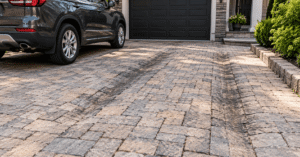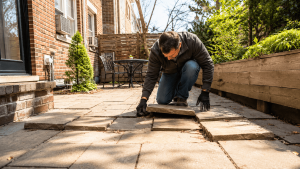
Paver edges start spreading when the edge restraint that holds the outer pavers in place fails, shifts, or was never anchored into a compacted base. Once the perimeter gives way, pavers push outward, joints open, and the surface loosens. On NYC driveways, patios, and walkways, freeze-thaw cycles, road salt, tight access, and drainage problems make this common. Below, we explain what causes edge spreading and how a proper edge restraint repair is done.
Quick Answer: What Causes Paver Edges to Spread
Interlocking pavers stay tight because of three things working together: friction between the pavers, sand-filled joints, and a restraint along the perimeter. The restraint is what keeps the whole system from drifting outward under weight and movement.
When edges spread, the cause is almost always one of these: the restraint is missing or the wrong type, it isn’t anchored into the base, the base under the edge is weak, or water is washing out the material supporting the outer pavers. Sand alone cannot solve any of these, which is why you need to address both the restraint and the base.
How to Tell If Your Pavers Are Spreading
Spreading usually starts quietly. Look for joints that are widening along the perimeter, a gap opening between the edge pavers and the lawn, planting bed, curb or wall, and edge pavers that lean or tilt outward.
Other signs include joint sand disappearing along one side, rows losing their straight line, and plastic edging that has lifted, cracked or become visible above grade. If you can see any of these, the problem is likely to keep progressing, especially through a winter.
The Main Reasons Paver Edges Spread
NYC replaces more than 2 million square feet of sidewalk each year, mostly on City-owned property and in residential neighborhoods with predominantly one-, two-, and three-family homes.
No restraint, or the wrong one. Some installations skip edge restraint entirely on sides that look protected by soil or grass. Others use lightweight plastic edging on a driveway, where turning tires and vehicle loads push hard against the perimeter.
Restraint that isn’t anchored properly. Spikes need to reach into a compacted base to hold anything. If they were driven into soft soil, or spaced too far apart, the restraint can move along with the pavers instead of resisting them.
A weak base at the perimeter. A stable edge depends on compacted base material that extends beyond the outer pavers. When the base stops right at the paver edge, or is loosely compacted there, the edge has nothing solid to push against.
Water at the edge. Downspouts discharging onto the paved surface, grading that sends runoff toward one side, and poor drainage can wash bedding sand and base fines out from under the outer pavers. Once that support is gone, the edge drops and drifts.
Freeze-thaw movement and road salt. Water in the base and bedding layers expands when it freezes and settles unevenly when it thaws. Salt exposure can also make some plastic edging brittle over the years.
Tree roots and vehicle loads. Roots lift and displace edges near planted areas, and vehicles turning at a driveway entry put repeated sideways pressure on the same few feet of pavers.
NYC Conditions That Make Edge Problems Worse
A paver driveway in Queens usually behaves differently from a small Brooklyn driveway. In Queens, cars often turn across the driveway apron, which concentrates lateral load at the entry. In Brooklyn, narrow driveways run tight against foundation walls and property lines, so edge pavers there may rely on a wall that was never built to act as a restraint.
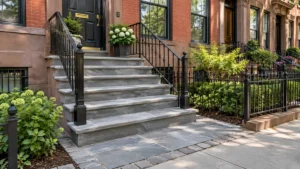
On older Brooklyn and Manhattan properties, we often see edge pavers set against aging masonry or brownstone-era front areas with no continuous restraint behind them. Staten Island driveways tend to be larger, with more lawn edge and grade change, which means more perimeter exposed to erosion and runoff.
Two conditions apply across the boroughs. Winter freeze-thaw cycles work on every weak point in the base, and road salt carried onto driveways and walkways speeds up wear on lighter edging materials. Where the paved area meets a public sidewalk or driveway apron, confirm any work with the official NYC DOT source before starting, since rules there are set by the city and not by the property owner.
How an Edge Restraint Repair Works
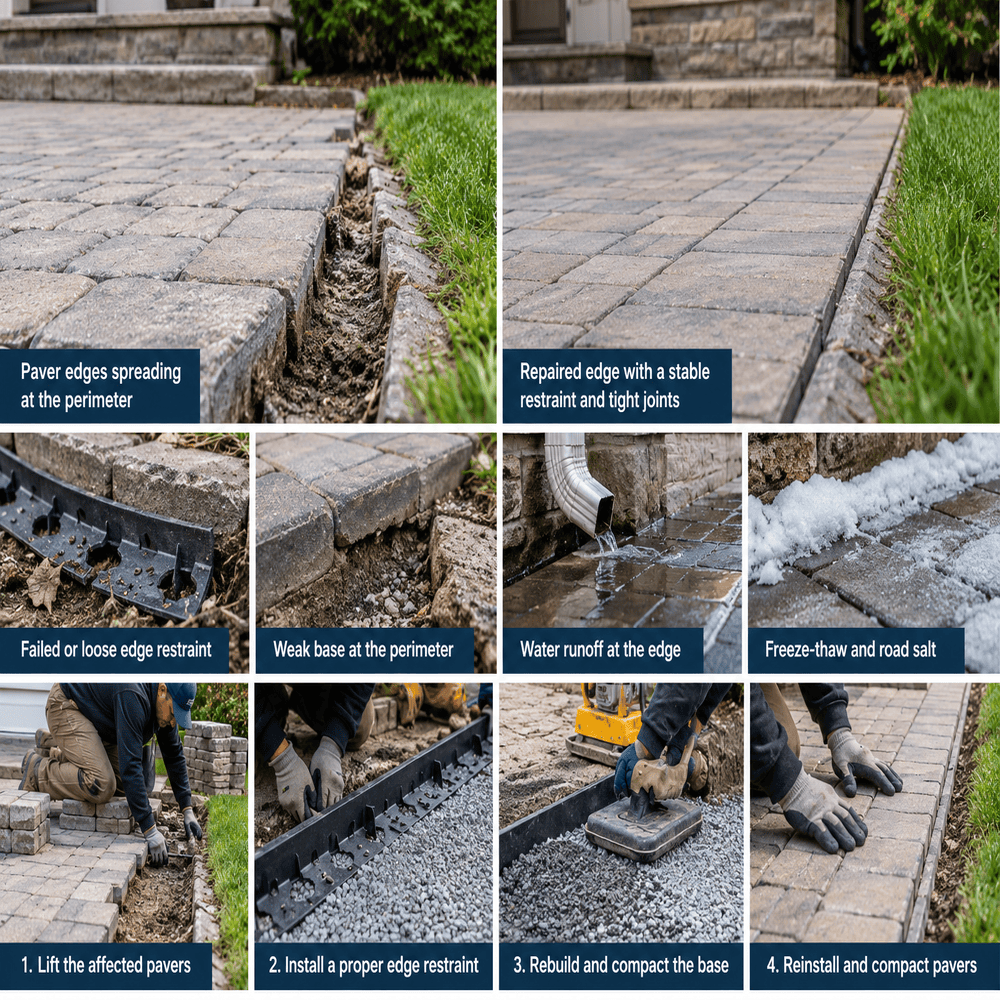
A proper repair fixes the cause of the movement, not only the visible gap. On NYC jobs, we typically follow this sequence.
- Diagnose the cause. Before lifting anything, we check whether the problem is missing restraint, poor anchoring, a washed-out base, or a drainage issue. This determines how much of the surface needs to come up.
- Lift the affected pavers. Remove the pavers along the failed edge, and often a few rows inward, and stack them in order. Keeping them organized makes it easier to preserve the original pattern and cuts.
- Rebuild the base and bedding at the edge. Remove the old bedding sand, then replace and compact any eroded or loose base material in lifts. The base is extended out past the line of the new edge so the restraint has firm support.
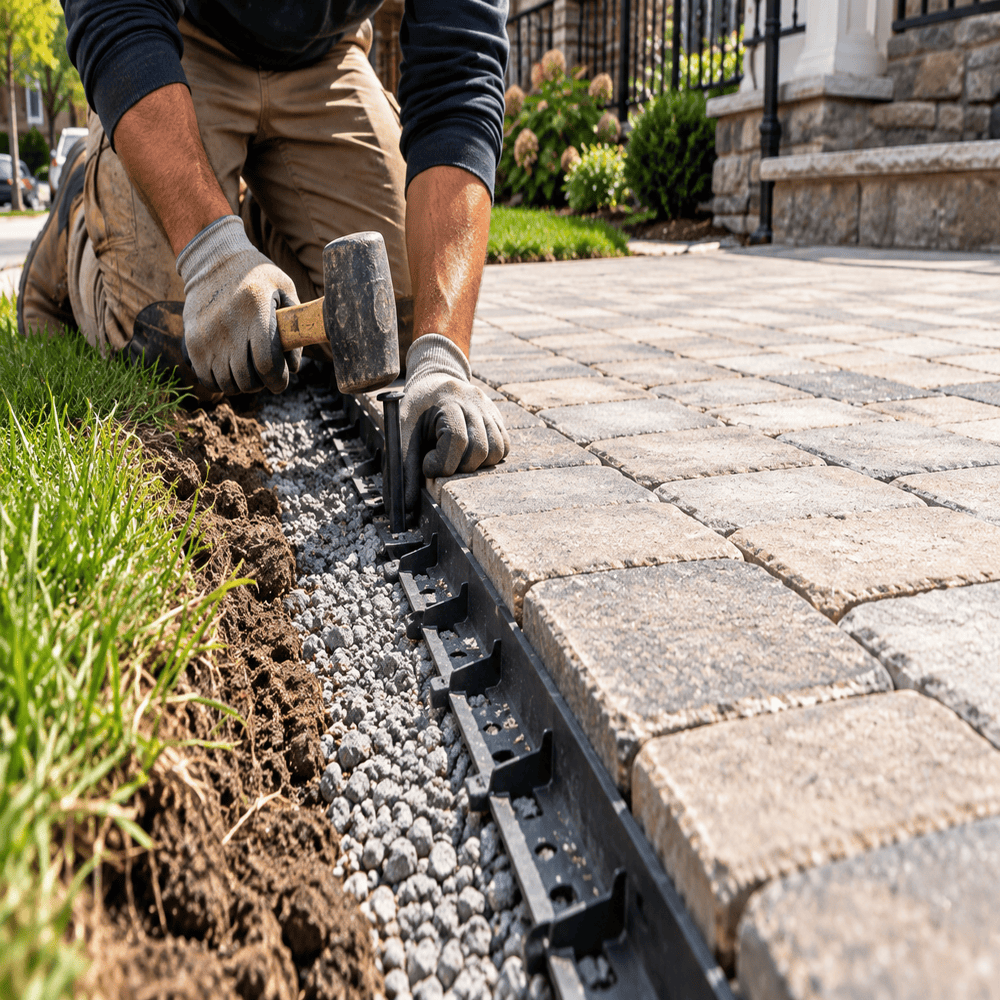
- Install the new restraint. The right type depends on the surface and the loads it carries (see the comparison below). Set it to the correct line and anchor it into the compacted base, not just the soil.
- Relay and compact the pavers. Reinstall the pavers in the original pattern, refit cuts as needed, and compact the area with a plate compactor so the surface sits level with the rest of the field.
- Refill the joints and correct the cause. Fill joints with sand and, where appropriate, use polymeric sand to help lock the surface together. If water was part of the problem, we correct grading or drainage at that edge so the repair doesn’t fail again.
Edge Restraint Options Compared
Plastic edging with spikes is the most common choice for patios and walkways. It works well where loads are light, and the installation is done correctly, but it is a weaker choice for driveways.
Aluminum or steel edging is thinner, stronger, and better suited to curves and moderate loads. It costs more than plastic, but holds its line better over time.
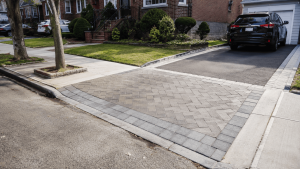
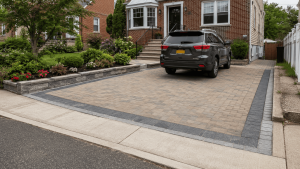
A concrete edge, sometimes called a haunch or curb, gives the strongest restraint and is the usual choice for driveways and vehicle areas. It takes more space, time, and access to install, which can be a factor on narrow NYC side passages.
Existing walls, curbs, and foundations can act as a restraint only if the pavers sit tight against them and the structure is stable. If a gap has opened, that edge is no longer restrained and needs attention.
Edge Repair or Full Section Reset?
If the movement is limited to the perimeter and the base across the middle of the surface is still firm, an edge repair is usually enough. If pavers are also sinking, rocking or dipping across the field, the base itself has failed, and a larger reset is more likely to hold. Our related guide on why pavers sink explains that situation in more detail.
Mistakes to Avoid
- Refilling the joints without fixing the restraint. New sand may hide the gap for a season, but the pavers will keep moving.
- Pushing the pavers back into place with nothing new behind them. Without a properly anchored restraint, they will drift out again.
- Using light plastic edging on a driveway. Vehicle loads need a restraint built for them.
- Ignoring drainage. A repaired edge sitting in a wet, eroding area will fail again.
- Driving spikes into soil instead of compacted base. The restraint looks installed, but it isn’t holding anything.
How to Choose the Right Repair Approach
When getting estimates for paver repair, ask a few specific questions. What type of edge restraint will be used, and why is it right for this surface? How will the base at the edge be rebuilt and compacted? How will the restraint be anchored? What will be done about drainage at the affected side?
A contractor who can answer these clearly is usually looking at the cause. One who only proposes topping up joint sand is likely treating the symptom.
Final Takeaway
Paver edges spread because the perimeter loses its support, whether from missing restraint, poor anchoring, a weak base or water. A lasting repair rebuilds the base at the edge, installs the right restraint for the load, and corrects the drainage that caused the failure.
If pavers on your Brooklyn, Queens, Manhattan or Staten Island property are drifting at the edges, NY Pavers can inspect the area and recommend the right fix. Request an estimate for professional paver repair in NYC.