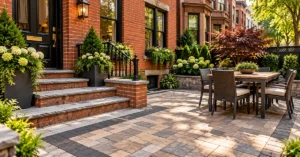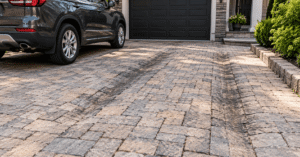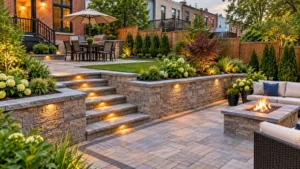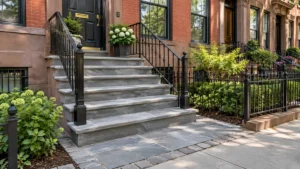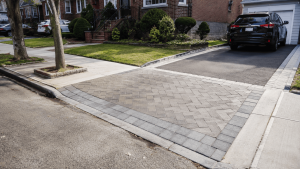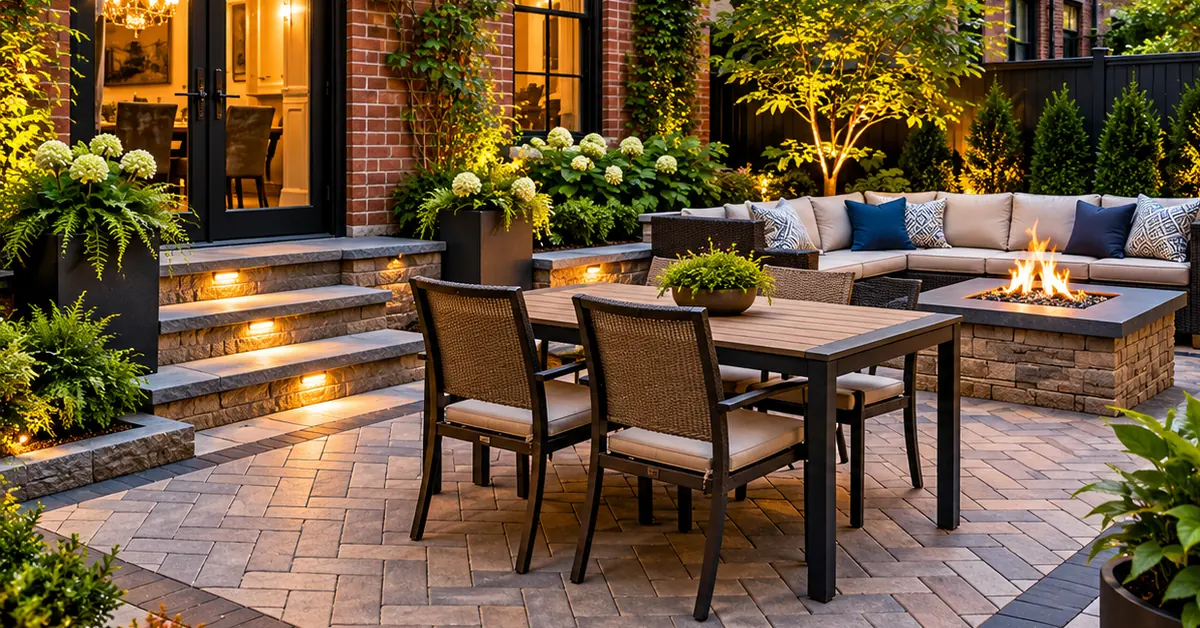
A small NYC patio can feel surprisingly spacious with the right paver layout. But choosing between herringbone, basketweave, running bond, and other small patio paver patterns isn’t just about appearance. The pattern influences how the eye moves through the space, how the pavers meet the edges, and how much cutting the installation requires.
For homeowners with narrow Brooklyn backyards, compact Queens courtyards, or small outdoor spaces in Manhattan and Staten Island, these details matter. A busy design can make a limited area feel crowded, while a simple, carefully planned layout can create a cleaner and more balanced appearance.
The right choice depends on your patio dimensions, the shape and size of the pavers, your home’s architecture, and your installation budget.
This guide compares six popular paver patterns for small NYC patios, explains their advantages, and helps you choose a layout that suits your outdoor space.
Quick Answer: Which Paver Pattern Works Best for a Small Patio?
Running bond is often the best all-around choice for a small patio because its staggered rows create a simple, organized appearance without overwhelming the space.
However, other layouts offer distinct advantages:
- Herringbone: Best for homeowners who want a dynamic, traditional pattern.
- Basketweave: A classic choice for brick townhouses and brownstone-style backyards.
- Stacked bond: Creates clean, modern lines, especially with suitable large-format pavers.
- Fan or cobblestone: Adds decorative character to traditional courtyards.
- Modular or ashlar: Uses different paver sizes to create a varied, less repetitive layout.
No single pattern works best for every property. Patio width, furniture placement, borders, drainage, and the selected paver system should all influence the final design.
Planning a new patio in NYC? NY Pavers provides professional paver patio installation, including material selection, layout planning, base preparation, and finishing. Request a free estimate to discuss the best option for your space.
Comparing the 6 Best Small Patio Paver Patterns
Before choosing a pattern, compare how each layout performs visually and what it requires during installation.
| Pattern | Best For | Visual Character | Installation Complexity |
|---|---|---|---|
| Running Bond | Narrow patios and simple layouts | Clean and balanced | Usually lower |
| Herringbone | Traditional patios and decorative designs | Dynamic and detailed | Moderate to higher |
| Basketweave | Brick homes and classic courtyards | Traditional and textured | Moderate |
| Stacked Bond | Modern patios and contemporary homes | Minimal and geometric | Depends on paver format |
| Fan / Cobblestone | Decorative traditional spaces | Curved and distinctive | Often higher |
| Modular / Ashlar | Patios needing a less repetitive design | Varied and natural | Depends on layout |
The complexity of each pattern can affect cutting, installation time, and material waste. However, the actual cost also depends on paver dimensions and the shape of the patio.
1. Running Bond: A Simple Pattern for Narrow NYC Patios
Running bond uses rectangular pavers arranged in staggered rows, similar to the layout of a traditional brick wall.
It creates a familiar, organized look without introducing too many competing lines. That makes it a practical option for smaller backyard patios and courtyards.
Why Running Bond Works in Small Spaces
The main advantage is visual simplicity.
The staggered joints create gentle movement across the surface without drawing too much attention away from the patio furniture, surrounding plants, or building.
The direction of the rows can also influence how people perceive the space.
For example, laying the long dimension of the pavers across a narrow yard may emphasize its width. Running the rows toward the back of the property can visually emphasize its depth.
Neither approach physically enlarges the patio, but the orientation can help create the impression you want.
Installation and Cost Considerations
Running bond can be efficient to install on rectangular patios because it often requires fewer complicated cuts than diagonal patterns.
However, patios with irregular edges, steps, drains, or several corners can still require detailed cutting.
Best choice for: Homeowners who want a timeless patio appearance, straightforward layout, and controlled installation complexity.
2. Herringbone: A Distinctive Pattern With Strong Interlocking Geometry
Herringbone uses rectangular pavers arranged in a repeating V-shaped or zigzag design.
Two popular variations are 45-degree and 90-degree herringbone. Both create a more detailed appearance than running bond.
Herringbone works especially well when you want the patio floor itself to become a design feature.
Is Herringbone Good for a Small Patio?
Yes, but the size of the pavers and the orientation of the pattern matter.
Smaller pavers create more visible joints, which can make a compact patio feel visually busy. A carefully chosen paver size, consistent color, and simple border can help balance the design.
Herringbone also looks attractive next to many traditional brick exteriors.
For example, a Brooklyn townhouse backyard with brick walls and simple black fencing may suit a gray or earth-toned herringbone patio.
Is Herringbone Stronger Than Other Patterns?
Herringbone provides excellent interlocking performance.
The Concrete Masonry & Hardscapes Association recommends herringbone patterns for many vehicle-loaded interlocking pavement applications because they resist horizontal movement effectively.
However, that doesn’t mean every residential patio needs herringbone for structural reasons. Pedestrian patios usually experience different loads from driveways.
You can review the CMHA’s technical guidance on interlocking concrete pavement construction for more information about laying patterns, base preparation, and installation.
Does Herringbone Cost More to Install?
It can.
Diagonal herringbone often requires additional cutting where pavers meet walls, fences, borders, and patio edges.
On a compact NYC patio, the perimeter can account for a significant share of the installation work relative to its overall area.
Instead of assuming a fixed surcharge, ask the contractor to compare the material quantities, cutting requirements, and total installed price for herringbone versus running bond.
Best choice for: Homeowners who want a classic, eye-catching design and don’t mind some additional layout complexity.
3. Basketweave: A Traditional Pattern for Brooklyn Brownstones
Basketweave creates a woven appearance by alternating the direction of rectangular paver groups.
It is one of the most recognizable traditional paving patterns and can complement older brick buildings, brownstones, and landscaped courtyards.
Why Basketweave Suits Historic-Style Homes
The pattern reflects traditional brick paving details without needing elaborate curves or several different colors.
For a small backyard surrounded by aged brick walls, basketweave can create a natural connection between the building and the new patio.
It can also work well in entry courtyards or outdoor seating areas where the homeowner wants a more traditional finish.
What Should You Consider?
Basketweave requires compatible paver dimensions to form the repeating pattern correctly.
Some combinations use rectangular units with proportions that allow two neighboring pavers to form a square module.
The wrong paver dimensions can disrupt the intended pattern or create awkward cuts.
For very small patios, using multiple contrasting colors may make the surface appear unnecessarily busy.
A single neutral color or subtle color blend often produces a more cohesive result.
Best choice for: Traditional Brooklyn and Queens homes where the patio should complement the property’s existing masonry.
4. Stacked Bond: A Modern Look for Compact Courtyards
Stacked bond arranges pavers in straight rows and columns, creating a consistent grid.
Unlike running bond, the joints line up rather than alternate.
This gives the patio a more geometric, contemporary appearance.
Why Stacked Bond Can Make a Small Patio Feel Open
Large-format pavers can reduce the number of visible joint lines across a patio, creating a less interrupted appearance.
Light-gray, beige, and other neutral finishes can strengthen the clean architectural look.
This style often works well in renovated courtyards, contemporary rear additions, and outdoor spaces with simple landscaping.
However, the correct paver type matters.
Not every concrete paver system or installation method suits the same stacked layout. The contractor should check the product’s intended application, support requirements, and manufacturer recommendations.
For homeowners who prefer a large-format finish, exterior porcelain pavers may also be worth comparing.
Installation Considerations
Straight lines can simplify some layout work, but stacked bond requires careful alignment because irregular joints become easier to notice.
Large-format units may also require special handling, different installation techniques, or more demanding substrate preparation.
Best choice for: Modern NYC patios where homeowners prefer simple geometry, fewer visual distractions, and a clean finish.
5. Fan and Cobblestone Patterns: Decorative Ideas for Traditional Patios
Fan patterns use curved arrangements of small paving units to create a repeating arch or fan-shaped design.
Belgian block and certain cobblestone-style pavers can produce this traditional appearance.
These layouts offer more visual character than straightforward rectangular patterns.
Where Do Fan Patterns Work Best?
A fan pattern can complement a courtyard with historic architectural details, traditional masonry, or a carefully planned garden border.
It may suit homeowners who want the patio to feel distinctive rather than minimal.
However, the pattern’s scale must fit the patio.
A complicated fan design can overwhelm a small backyard if the paving units are too small or the layout contains too many competing borders.
Installation and Cost Considerations
Curved layouts require precise planning, fitting, and alignment.
Some paving systems offer units specifically designed for decorative patterns, while others require extensive hand fitting and cutting.
This can increase installation labor.
Best choice for: Homeowners who value traditional craftsmanship and want a decorative patio with strong visual character.
6. Modular or Ashlar Patterns: A Balanced Alternative
A modular or ashlar-style layout combines compatible pavers of different sizes to create a varied surface.
Instead of repeating one uniform brick or square, the design uses a planned combination of rectangular and square units.
The result can feel less rigid than stacked bond and less directional than herringbone.
Why It Works for Small NYC Backyards
A well-planned modular layout gives the patio texture without requiring a dramatic geometric pattern.
It also allows homeowners to choose pavers with natural-looking color blends and subtle surface variation.
This can be particularly attractive in backyards that connect to gardens, stone steps, or existing masonry.
However, larger modules should fit the patio dimensions. A layout with too many different sizes can appear fragmented in a very narrow space.
Best choice for: Homeowners who want a flexible design that feels natural and coordinated without strong repeating lines.
How to Make a Small NYC Patio Look Bigger With Pavers
The paver pattern matters, but it is only one part of the design.
For many compact patios, the combination of paver size, color, border treatment, and furniture layout can influence the overall appearance more than the pattern alone.
Choose a Consistent Color Palette
Using fewer competing colors can make a small patio appear more organized.
Gray, beige, tan, and other neutral shades often work well with brick buildings and modern outdoor furniture.
A subtle color blend can add depth without creating an overly busy surface.
Avoid Oversized Decorative Borders
Borders can frame a patio beautifully, but wide, contrasting borders also take up visual space.
For small patios, a narrow border or a simple matching edge detail may create a cleaner appearance.
Plan the Pattern Around Furniture
Before finalizing the paver direction, think about where the dining table, outdoor sofa, grill, and planters will sit.
A strong pattern may look attractive on its own, but much of the finished surface could disappear beneath furniture.
The most effective design should still look balanced after you furnish the patio.
Keep Walkways and Steps Connected
If the patio connects to a rear entrance, side walkway, or garden steps, consider how the paver pattern will transition between these areas.
Matching materials or carefully planned borders can make separate spaces feel connected.
A small patio doesn’t need the most complicated pattern. It needs a layout that makes good use of the available space.
What Affects the Cost of Different Paver Patio Patterns in NYC?
Pattern complexity can affect labor costs, but homeowners should consider the complete installation.
A straightforward running bond layout may require less cutting than a diagonal herringbone or custom fan pattern.
However, total project cost also depends on several other factors.
| Cost Factor | Why It Matters |
|---|---|
| Patio dimensions | Determines the installation area and material quantities |
| Paver material | Concrete, porcelain, and natural stone have different material and installation costs |
| Pattern complexity | Influences layout planning, cutting, waste, and installation time |
| Patio shape | Irregular corners and curved edges can require additional cuts |
| Site access | Narrow NYC passages may increase material handling and labor |
| Base preparation | Existing soil, drainage, and excavation requirements affect the work |
| Borders and transitions | Special edges, steps, drains, and adjoining surfaces add detail |
A simple pattern will not automatically make a patio inexpensive if the property needs extensive excavation or drainage corrections.
Likewise, a more decorative pattern may be reasonable when the patio has a simple shape and the selected pavers suit the layout.
The best way to compare costs is to request estimates based on the same patio dimensions, materials, and site conditions.
NY Pavers can help you review layout options during a free patio installation estimate.
Why Proper Installation Matters More Than Pattern Alone
Even the most attractive paving pattern cannot compensate for a weak foundation.
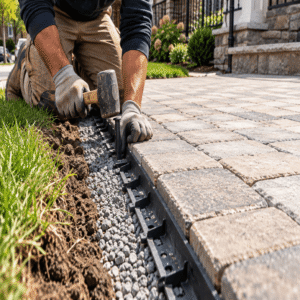
A durable patio needs a suitable installation system, stable base, drainage planning, appropriate edge support, and correct joint details.
Without these elements, individual pavers may settle, move, or develop uneven joints regardless of their arrangement.
During a patio project, the contractor should review the existing ground, finished surface elevations, access, and drainage before installing the pavers.
This matters particularly in NYC backyards, where old concrete, narrow access routes, and surrounding buildings can complicate excavation and grading.
When comparing contractors, ask how they plan to prepare the base and finish the patio edges—not just which pattern they recommend.
Why Choose NY Pavers for Your Small NYC Patio?
NY Pavers brings more than 23 years of experience in paving, masonry, and exterior hardscape work across New York City.
We install concrete pavers, porcelain pavers, bluestone, and natural stone for patios, courtyards, walkways, and other outdoor spaces.
For a small patio, we can help homeowners evaluate the available dimensions, existing surface, drainage requirements, preferred materials, and suitable paving layouts.
Whether you prefer traditional herringbone, classic basketweave, simple running bond, or a modern large-format design, the goal is to create a finished patio that complements your property and works for everyday use.
Our service areas include Brooklyn, Queens, Manhattan, and Staten Island.
Ready to Upgrade Your Small Backyard?
You don’t need a large backyard to create a comfortable outdoor space.
A well-planned paver patio can provide a dedicated area for outdoor dining, seating, or relaxing while complementing your home’s architecture.
Tell NY Pavers about your patio dimensions, location, existing surface, and preferred design.
Call (718) 838-0982 or request your free on-site estimate.
Frequently Asked Questions About Small Patio Paver Patterns
What is the best paver pattern for a small patio?
Running bond often works well because its staggered rows create a simple and balanced appearance. Herringbone, basketweave, and stacked bond can also suit small patios depending on the paver size, patio dimensions, and preferred design.
Does herringbone make a small patio look bigger?
Herringbone can create visual movement, especially when the pattern follows a carefully planned direction. However, smaller pavers and dense joints may make some spaces look busier. Pattern scale and color affect the result.
Is running bond cheaper than herringbone?
Running bond may require fewer complicated cuts on rectangular patios, which can reduce labor. Herringbone often requires additional perimeter cuts. The actual price difference depends on the paver dimensions, selected materials, and site conditions.
Is basketweave suitable for a Brooklyn brownstone backyard?
Yes. Basketweave can complement traditional brickwork and historic-style architecture. Neutral paver colors and carefully proportioned units can help the pattern feel balanced in a compact backyard.
Are large pavers better for small patios?
Large-format pavers can create a cleaner appearance with fewer visible joints, but they are not automatically the best option. Product dimensions, patio shape, installation method, edge conditions, and waste should guide the choice.
Does the paver pattern affect patio durability?
The pattern can influence how individual paving units interlock, particularly under vehicle loads. For residential patios, proper base preparation, drainage, edge restraints, material selection, and installation quality remain essential.
Does NY Pavers provide free patio installation estimates?
Yes. NY Pavers provides free on-site estimates for suitable patio installation projects in Brooklyn, Queens, Manhattan, and Staten Island. Call (718) 838-0982 or submit your project details through our contact form.