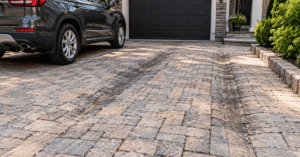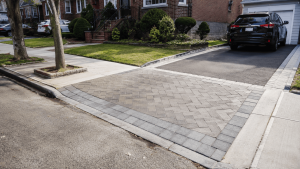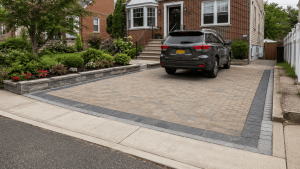
Too much sand under pavers is one of the most common installation issues in NYC, and it is also one of the easiest to fix without ripping everything out.
If your pavers rock underfoot, sink in certain areas, or move too much, too much sand in the bedding layer is often the cause. Here is how to diagnose it and fix it properly without a full reinstall.
How Will You Know If Too Much Sand Is Causing a Problem?
Before you start removing pavers, confirm the type of problem you are dealing with.
Excess bedding sand can cause specific symptoms:
- Rocking pavers that wobble underfoot even though they look level
- Uneven sinking, usually in high-traffic areas such as walkways
- A soft feel underfoot, with slight give or flex when you walk on the surface
- Edge pavers moving outward as the perimeter slowly pulls away from the center
The clearest sign is inconsistency. If some pavers feel firm while others feel loose or keep settling, the sand layer is not settling evenly. That is a classic sign of an overly thick sand layer.
However, if the entire surface has sunk evenly, the gravel base under the sand is more likely the problem, not the sand itself. That repair is different and usually more complicated.
What You’ll Need
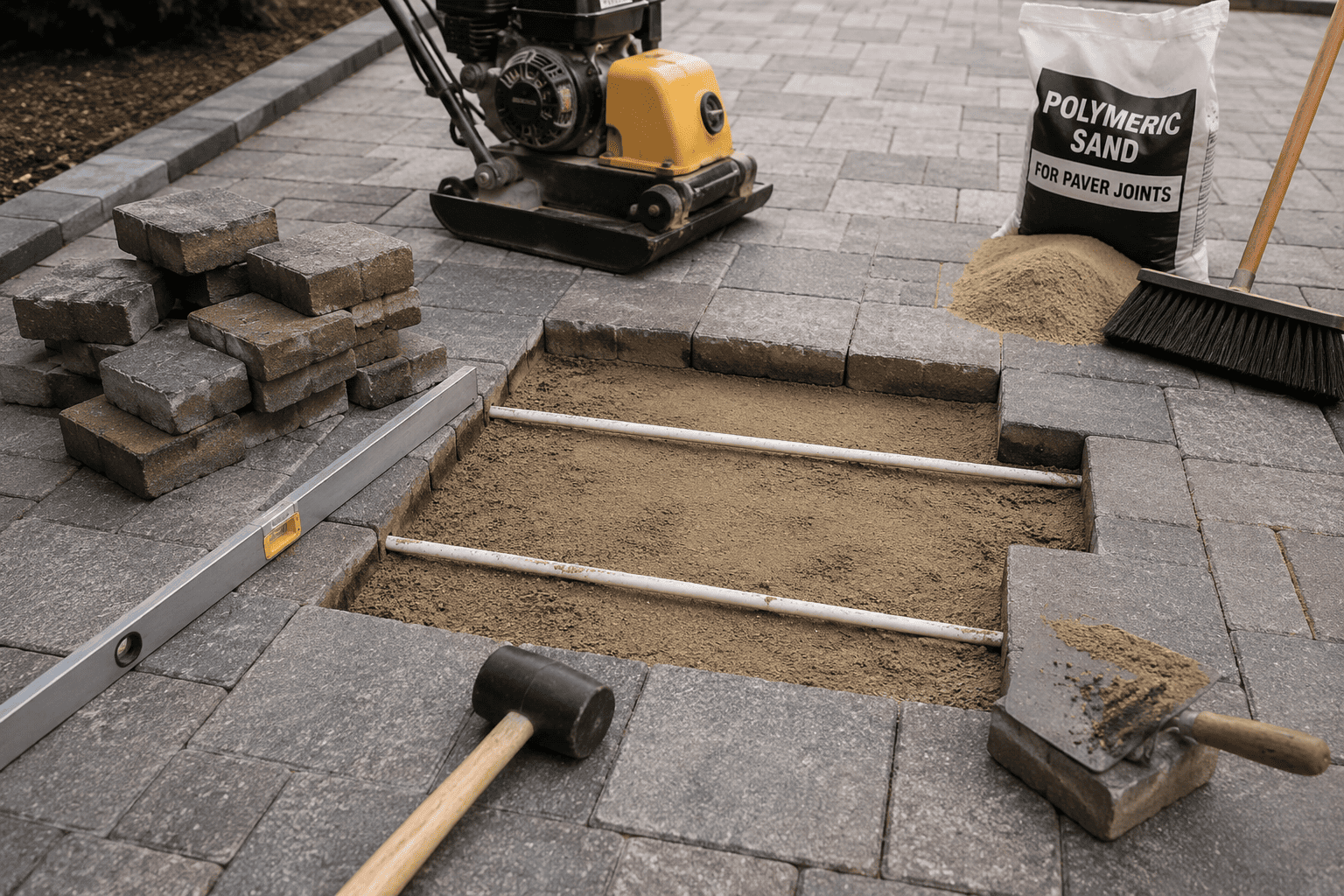
- Flat pry bar or paver puller
- Rubber mallet
- Plate compactor or hand tamper
- Screed pipes or a straight edge
- Coarse concrete sand to replace or top up as needed
- Polymeric jointing sand
- Leaf blower or broom
Step 1: Remove the Affected Pavers
Start by removing the pavers in the problem area. Lift the first paver with a flat pry bar by gently inserting the tool into the joint and prying it up carefully without chipping it. Once the first paver comes out, the others usually follow more easily.
If the pattern matters, stack the pavers in order next to each other. This is not very important with a running bond or another simple pattern, but it saves time when you reinstall a more complex pattern.
Start in the most damaged section and work outward until you expose all the pavers that are rocking or settling, plus one full row beyond that. That outer row gives you a reference for the correct finished height.
Step 2: Remove Excess Sand
Once you remove the pavers, the sand bed underneath will be exposed. If the sand is deeper than 1 to 1.5 inches anywhere, remove the excess.
Use a straight edge or screed pipe to check the depth. Your target is a consistent 1-inch layer across the entire exposed area. You can remove sand by hand or with a small shovel. Precision matters less than consistency.
If the sand is wet, lumpy, or mixed with soil or debris, remove all of it and replace it with fresh coarse concrete sand. Old contaminated sand will not hold up in a proper repair.
Step 3: Re-Screed to the Correct Depth
Place two screed pipes parallel across the open area on top of the existing gravel base. Set them at the right height so they leave a 1-inch sand layer after you level the area.
Then spread fresh coarse concrete sand over the repair area and drag a straight board across the pipes to create a level 1-inch bed. Carefully remove the pipes and fill the channels with sand, then smooth them gently by hand.
Do not walk on the screeded sand before placing the pavers back. Even one footprint can create a dip that throws off the surface.
Step 4: Replace the Pavers
Set the pavers back into place, starting from the stable outer reference row and working inward. Lower each paver straight down instead of sliding it, because sliding disturbs the sand bed. Then tap each paver into place with a rubber mallet until it sits level with the surrounding surface.
Use a straight edge or level every few rows as you go. If one paver sits too high, too much sand is still under it, so lift it, remove a little sand, and reset it. If one sits too low, add a small amount of sand and reset it.
Step 5: Compact and Re-Sand the Joints
Once you reset and level all the pavers, compact the repaired area with a plate compactor. This final compaction settles the sand and locks the pavers into place. Make at least two passes in opposite directions.
After compaction, spread polymeric jointing sand across the surface and sweep it into the joints with a broom. Then use a leaf blower to clear off the excess.
Next, apply a light mist of water to activate the polymeric binder. This helps lock the joint sand in place and reduces washout and weed growth.
This Fix Isn’t Enough When…
This repair works well if the problem stays limited to the sand bedding layer. However, it will not solve the issue if:
- The gravel base under the sand is too shallow or poorly compacted. In NYC, patios should have at least 6 inches of base, and driveways should have at least 8 inches.
- The soil underneath is soft, wet, or poorly drained.
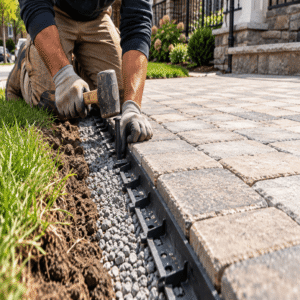
- Edge restraints are missing, which allows the entire surface to spread outward.
If you remove the pavers and find only 2 to 3 inches of gravel base, or no gravel at all with sand placed directly over soil, you will need to reinstall the whole surface. In New York’s freeze-thaw conditions, no long-term fix will hold up on a weak foundation.
That is the harder answer to hear. Still, it is better to find out now than to keep resetting pavers every spring.
Why NY Pavers
NY Pavers can handle both situations, whether the job needs a sand-layer correction or a full reinstall built properly from the ground up.
Free estimates are available throughout Queens, Brooklyn, Staten Island, Manhattan, and Long Island.
Call (718) 838-0982 or visit nypavers.com.