Urban garden design ideas aren’t about squeezing more plants into a tiny space — they’re about changing how the space feels. In most cities, gardens are tight, boxed in, and surrounded by walls, which makes even a well-kept yard feel cramped. The right urban garden design ideas use layout, light, and smart material choices to create the illusion of space, making small city gardens feel open, calm, and intentional instead of crowded.
But here’s the thing, you don’t need more square footage; you need to stop your brain from noticing how small the space actually is. It’s all about optical illusions and smart choices. Here’s the straight talk on how to make a cramped urban plot feel like it actually has some room to breathe.
Kill the Clutter Immediately
The fastest way to make a tiny yard feel like a closet is to fill it with “stuff.” If you have three different types of pots, a bulky grill, and mismatched chairs, you’ve already lost. You need a dead-simple layout. Define where you walk and where you sit, and keep the middle as clear as possible. If the eye can see the floor from one end to the other, the space instantly feels bigger.
Look Up (Because the Ground is Full)
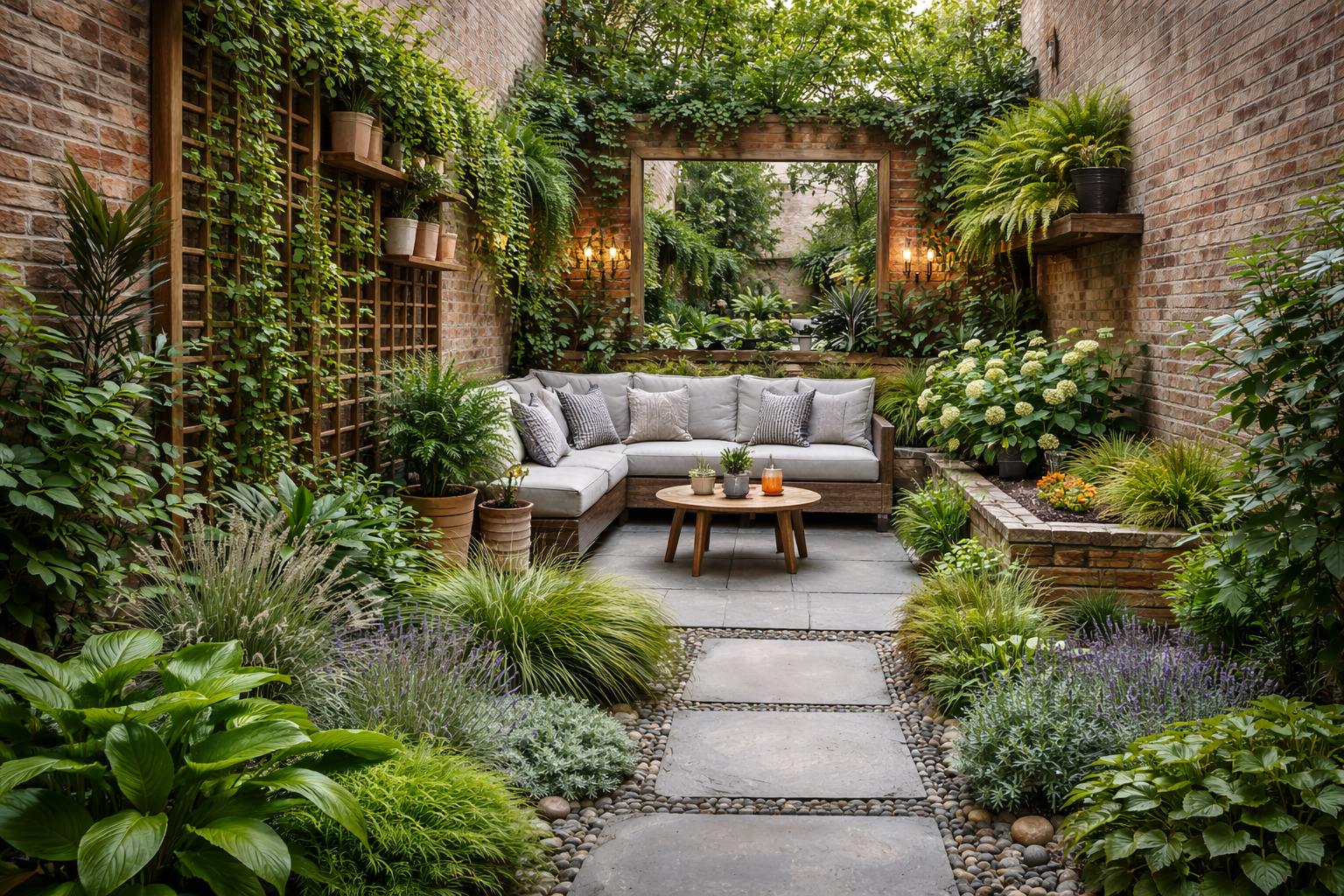
If you can’t go out, go up. This is the oldest trick in the book for a reason. Instead of taking up precious floor space with massive pots, use trellises, living walls, or hanging planters. When you draw the eye upward, you stop focusing on the narrow walls and start noticing the height. It turns a “cramped” space into a “cozy” one.
Lighten Up the Color Palette
Dark colors are the enemy of small spaces. If you’ve got dark wood fences and charcoal pavers, the walls are going to feel like they’re closing in on you. Switch to light stone, pale concrete, or even just a coat of off-white paint on a back wall. Light bounces around; dark sucks it up. The more light you reflect, the more the boundaries seem to push back.
Stop Using Hard Borders
If you put a thick, solid hedge or a massive stone border right at the edge of your patio, you’re just highlighting exactly where the space ends. Instead, layer your plants. Put the small stuff up front and the taller stuff in the back. This “blurring” of the edges tricks your brain into thinking there’s more depth than there actually is. You want the edges to feel soft, not like a prison wall.
Stick to a “Two-Material” Rule
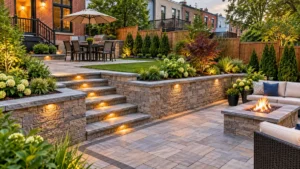
One of the biggest mistakes in urban DIY is buying five different types of stone and wood because they all looked cool at the store. In a small space, that variety creates “visual noise” that makes the yard feel chaotic and tiny. Pick two, maybe three, materials and stick to them. Use the same stone for the path and the edging. That continuity makes the whole garden feel like one big, intentional space.
Everything Needs a Double Life
In a city garden, nothing should have just one job. If you’re building a planter, make the edge wide enough to be a bench. If you need a storage box for tools, put a cushion on top of it. Built-in furniture is a lifesaver here because it hugs the walls and keeps the center of the yard open for actual living.
Use Mirrors (Yes, Really)
It sounds like a cheap interior design trick, but a well-placed outdoor mirror or a glossy, reflective water feature can literally double the perceived size of a yard. Tuck a mirror behind some greenery at the end of a path, and suddenly it looks like the garden keeps going. It’s a total mind-game, and it works every time.
Don’t Let the Plants Take Over
We all want a jungle, but in a 10×10 space, a massive, overgrown bush is basically a squatter. It’ll eat your space in one season. Pick plants that grow slowly or stay compact. And don’t be afraid of “empty” space. A patch of clean gravel or a clear walkway gives the eye a place to rest, which makes the whole area feel more expansive.
Light Up the Corners
A dark garden at night feels like a hole. If you only have one bright light over the back door, the rest of the yard disappears into a black void, making it feel tiny. Use soft lights to illuminate the very back corners and the tops of your plants. By lighting up the boundaries, you’re showing your brain exactly how much space you have, even after the sun goes down.
The Bottom Line
Urban gardening isn’t about how much you can cram into a small space, it’s about how much you can take away. Smart urban garden design ideas focus on simplicity, vertical space, and visual flow, helping small city gardens feel open, functional, and far more inviting year-round. Simplify the materials, use the walls, and keep the colors light. You’re not just growing plants; you’re managing a footprint. If you design it smart, you’ll forget you’re in the middle of a crowded city the second you step outside.